

By Dan Milburn | Updated: March 15, 2026
If you’re reading this, you’ve probably got a “junk drawer” full of sputtering, clicking, and dead torch lighters. You might even be frustrated, thinking you just got another “lemon.”
After 18 years of taking these things apart on my workbench, I’m here to tell you that most of those lighters aren’t lemons. They were killed by simple maintenance mistakes that could have been prevented.
The difference between a torch that lasts 3 months and one that lasts 10 years isn’t the price tag; it’s the ownership ritual. In this guide, I’m going to skip the generic troubleshooting and get right to the physical reasons your lighters stop working—and the monthly ritual you can use to make sure your favorite torch never fails when you need it most. Before you toss another lighter in the trash, let’s see which “hidden killer” got it.
Disclosure: LighterPoint.com is a participant in the Amazon Services LLC Associates Program, as well as other affiliate programs, designed to provide a means for us to earn fees by linking to Amazon.com and affiliated sites at no extra cost to you. Please see the Affiliate Disclosure for more details.
Hidden Killer #1: Pocket Lint (The “Silent” Jet Clog)
Most people carry their lighter in a pocket with keys, coins, and receipts. Over time, microscopic fibers (lint) find their way into the burner well.
- The Physics of Failure: When you ignite the lighter, that lint doesn’t just sit there—it burns and turns into a tiny, carbonized “plug.” This plug disrupts the fuel-to-oxygen ratio, causing that annoying orange flame or the “sputter.”
- The Fix: If your lighter doesn’t have a protective cap, you must blow it out with compressed air once a week. I tell my friends, “A capless lighter is a ticking clock.”
Hidden Killer #2: Thermal Shock (The “Over-Firing” Trap)
Torch lighters are essentially miniature jet engines. They are designed for short, intense bursts (3–5 seconds), not for staying lit like a candle.
- The Physics of Failure: If you keep a torch lit for 30+ seconds (common when lighting multiple cigars or campfires), the heat transfers from the burner plate to the internal rubber O-rings. These O-rings then “bake” and become brittle.
- The Result: Once an O-ring cracks, you get the “Ghost Hiss”—a permanent leak that makes the lighter useless.
- Quick Tip: Never fire a torch for more than 10 seconds at a time. If it needs more, let it cool for 10 seconds before the next strike.
Hidden Killer #3: The “Freezer Fill” Myth
There is an old forum legend that says you should put your lighter in the freezer before filling it to get more gas inside.
- The Physics of Failure: While it does allow more gas in, the extreme cold causes the internal plastic tank and rubber seals to contract at different rates. This often leads to “stress fractures” in the tank.
- Quick Tip: Fill your lighter at room temperature. If you want a “fuller” tank, simply purge the air more effectively. Don’t risk a $100 S.T. Dupont in a $400 freezer.
Hidden Killer #4: The “Over-Torqued” Adjustment Wheel or Screw
Most lighters have a stop point on the flame adjustment screw. When a lighter starts to weaken, the natural instinct is to grab a screwdriver and crank it toward the (+) as hard as possible.
- The Physics of Failure: The internal regulator is often made of brass or plastic. If you force it past the factory “stop,” you can strip the threads or snap the needle valve inside. Once that happens, the lighter will either leak constantly or never let gas through again.
- Quick Tip: If the lighter isn’t lighting at the 75% mark, cranking it to 110% isn’t the answer—cleaning the jet is. Never force the dial.


For Problem Lighters, Check Out The Ultimate Lighter Troubleshooting Guide
Hidden Killer #5: Fingerprint Acid & Ceramic Fouling
The white ceramic plate around your igniter isn’t just for show; it’s an insulator. Over time, oils from your skin or soot from “testing” the flame with your finger (we’ve all done it) coat that ceramic.
- The Physics of Failure: Carbon and skin oils are conductive. Instead of the spark jumping from the wire to the jet, it “crawls” across the dirty ceramic to the nearest piece of metal. This is why you hear a “click” but see no spark.
- Quick Tip: Every few months, wipe that white ceramic plate with a Q-tip dipped in high-purity alcohol to keep the spark path clean.
Hidden Killer #6: The “Cheap Gas” Paraffin Build-up
We’ve talked about gunk before, but here is the specific mechanical reason it kills the lighter.
- The Physics of Failure: Low-quality butane contains paraffin wax. As the gas expands and cools at the nozzle, the wax solidifies. It’s like cholesterol in an artery. Eventually, the opening becomes so narrow that the “jet” becomes a “flicker.”
- Quick Tip: See my guide on the best butane for your lighters. Stick to 5x refined or higher to keep those “arteries” clear.

Shop High Quality Butane At Amazon
Hidden Killer #7: Storage Pressure “Bleed-off”
If you leave a lighter completely full and unused for months (like in a seasonal camping kit or a car), the constant pressure on the internal seals can cause them to “set” or flatten.
- The Physics of Failure: Rubber seals need occasional movement to stay supple. Constant high pressure without use can cause a seal to fail the moment you finally click the trigger.
- Quick Tip: If you aren’t going to use a lighter for more than 3 months, bleed it down to about 25% capacity. It keeps enough pressure to hold the seals in place without over-stressing them.
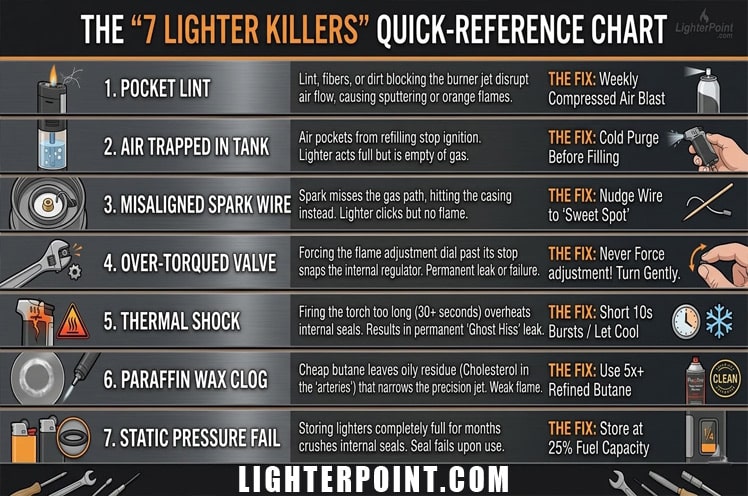
Quick-Reference: The 7 Lighter Killers
| Killer | The Symptom | The Prevention |
| 1. Pocket Lint | Orange, dancing flame | Use a cap or weekly air blast. |
| 2. Thermal Shock | Sudden internal leaks | Keep burns under 10 seconds. |
| 3. Freezer Fills | Cracked fuel tank | Always fill at room temperature. |
| 4. Over-Torque | Dial spins freely/no gas | Never force the adjustment screw. |
| 5. Ceramic Fouling | No visible spark | Wipe ceramic with alcohol. |
| 6. Paraffin Wax | Weak, “lazy” flame | Use 5x+ refined butane only. |
| 7. Static Pressure | Fails after long storage | Store at 25% fuel capacity. |
The “Lighter Life-Extension” Monthly Ritual
Instead of waiting for it to fail, I perform this 3-step ritual on my entire collection on the first of every month. It takes 2 minutes and saves me hundreds in replacements.
- The Compressed Air “Blast”: Blow out the burners AND the air intake vents.
- The Alcohol Swab: Use a Q-tip with 90% Isopropyl alcohol to clean the ceramic igniter plate. This ensures the spark doesn’t “leak” to the side of the metal casing.
- The “Dry Strike” Check: Click the igniter without gas flowing to ensure the spark is hitting the center of the jet. If it’s off, nudge it with a toothpick.
Frequently Asked Questions: Understanding Lighter Failure
Why does my torch lighter work for a week and then stop?
This is almost always due to Refill Contamination. If you didn’t purge the air out before your first refill, an air pocket has likely moved to the intake. It feels like the lighter is full, but it’s just spitting air. Perform a total bleed and refill with premium gas.
Can I fix a lighter that is leaking from the bottom?
If it’s hissing from the fill valve, sometimes the O-ring is just dry. Try a reset: depress the valve quickly with a tool to blast out any debris, then refill. If it continues to hiss, the seal is likely torn, and for safety reasons, the lighter should be replaced.
Why is my flame suddenly orange instead of blue?
An orange flame means incomplete combustion. Your lighter is choking on something—usually pocket lint or dust in the burner. This lowers the temperature of the flame and will eventually clog the jet entirely. Use compressed air to clear the throat of the burner.
Does the altitude actually break a lighter?
Altitude doesn’t break the mechanical parts, but it changes the physics of the flame. Thinner air means less oxygen for the mix. High-altitude use can foul the igniter over time because the fuel doesn’t burn off cleanly. If you live above 4,000 ft, you need a high-pressure fuel like Xikar Purofine.
Why does my lighter ignite better when I turn the flame down?
This is a classic sign of Spark Overload. If the gas pressure is too high, the butane blows out the spark before it can ignite. By turning it down, you’re slowing the gas velocity enough for the spark to catch. If you have to keep it on the lowest setting to work, your igniter wire is likely too far from the jet.
Is it true that clicking the lighter too fast can ruin it?
Yes. Rapid-firing a piezo igniter creates a thermal load on the tiny crystal inside. If you click it 10 times in five seconds, the crystal can lose its ability to generate a high-voltage spark. Slow, deliberate clicks are better for the longevity of the mechanism.
Can old butane go bad inside the lighter?
Butane itself doesn’t expire, but the additives (the smells) can settle over the years. If a lighter has been sitting for 5+ years, I recommend purging it completely. The heavy ends of the fuel can concentrate at the bottom and gunk up the valve on the first strike.
Why does my torch lighter struggle in cold weather?
Butane is stored as a liquid and needs heat to turn into a gas. In cold weather, the vapor pressure drops significantly. If the lighter is cold, the gas won’t flow fast enough to ignite. Keep your lighter in an inner pocket close to your body heat during the winter months.
Why does my lighter spark but only produce a tiny flicker?
This is the Paraffin Clog. Your jet is partially obstructed by wax from low-quality fuel. You can sometimes melt this out by carefully heating the top of the lighter (without igniting it) with another flame for a few seconds, but the real fix is switching to 9x refined gas.
Are expensive lighters actually more reliable?
Mechanically, a $15 Vertigo and a $150 Colibri work similarly. The difference is in the seal quality and the warranty. Luxury lighters use higher-grade gaskets that resist Thermal Shock better, but even a $500 Dupont will fail if you use gas-station butane in it.
The Conclusion
Stop Treating Your Torch Like a Disposable
The reason most torch lighters stop working isn’t a lack of quality—it’s a lack of maintenance. By avoiding the “7 Lighter Killers” and sticking to a monthly cleaning ritual, you can turn a “six-month lighter” into a decade-long companion.
Which ‘killer’ got your last lighter? Let me know in the comments. If you describe the symptom, I’ll tell you if it’s worth fixing or if it’s time to head over to my Most Reliable Torch Lighter for an upgrade.

- How to Clean a Torch Lighter - July 12, 2025
- Best Torch Lighter Brands for Cigars in 2025 - July 3, 2025
- Best Pocket Torch Lighters In 2025 - June 30, 2025